What Does Plantation Lily (Hosta Patriot) Look Like?
It is a Tuesday evening in June, you are standing at the edge of the shade bed with a hose in your hand, and the hosta you bought as 'Patriot' does not match the picture on the tag. The white looks narrower than you expected, or the green is glossier, or the clump is smaller than the photo promised. Most photos of this plant are taken at its best, in soft light, just after rain, before the slugs have found it.
We'll walk you through the plant as it looks on an ordinary day, then work inward. We start with the whole bed seen from across the yard, then the plant's place in the border, one clump up close, a single leaf, and how the look shifts from spring emergence to frost. By the end you should know whether you are looking at Plantation Lily, and what a normal off day looks like.
The Whole Bed From the Back Fence
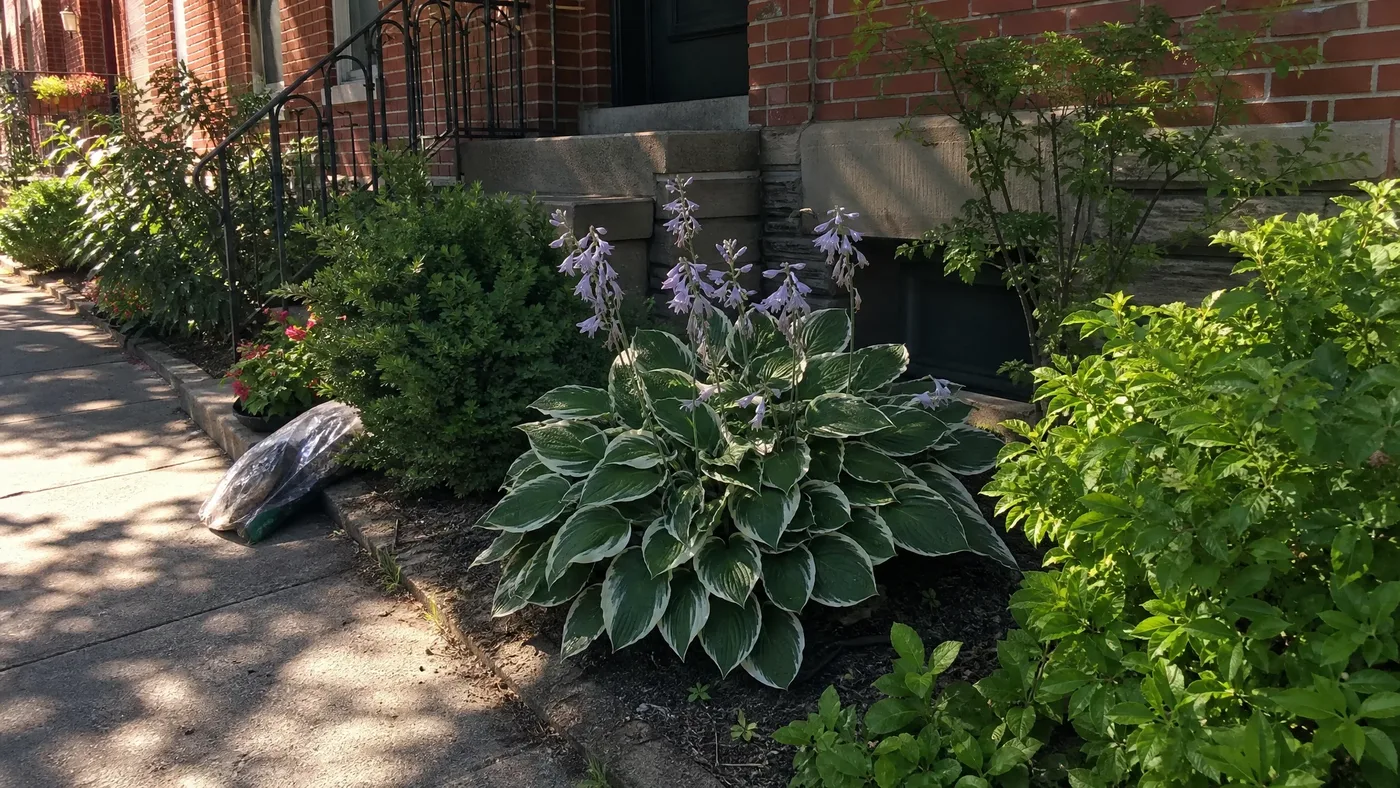
Stand at the back fence, or at the far edge of the lawn, and a bed of Plantation Lily stops being a collection of leaves. It becomes a field of dark green mounds with a pale, broken line running around each one. Nobody sees veins from there. What registers is contrast, and this hosta carries more of it than most.
The white margin is the reason the planting works at a distance. Dark green sinks into shade as the light drops, while the ivory edges hold on, so around dusk the bed looks as if someone traced it in chalk. A solid green hosta bed in the same spot goes flat and dark by comparison.
How Spacing Changes the Picture
Spacing decides how that white reads. Clemson Extension tells you to space plants 1 to 3 feet apart, and which end you pick matters. Plant near 1 foot and the mounds touch, so the margins knit into a wavy white ribbon through the bed. Plant near 3 feet and you see separate clumps with mulch showing between them.
We lean toward the tighter end when you want a mass effect, because a gappy bed shows more mulch than hosta for the first couple of years. The price is a bit of dividing later, which is a better problem than staring at bare ground.
What You Lose at a Distance
Distance strips out everything fine. The glossy surface, the ribbing and the lavender-blue flower stalks of summer all melt into the general green. If you want the bed to read as a pattern from the house, the margins have to do the work, and they only stay crisp in shade.
That is also why the neighbors matter. Our guide to landscape ideas and companion plants covers what to set beside it so the white has something calm to sit against.
Where Plantation Lily Sits in the Border
Patriot is a big hosta, and it behaves like one in a border. The cultivar reaches a maximum of roughly 1½ to 3 feet in both height and spread, while the hosta genus as a whole runs from 4 inches to 2½ feet tall and up to 3 feet wide. That puts Plantation Lily at the large end of the family, well past the little edging types.
The genus growth rate is rated medium, so a new clump looks modest for a season or two and then fills its spot. Our guide on how big Plantation Lily gets has the longer version, but for planning, leave the room and be patient.
Front, Middle or Back
This is a middle-of-the-border plant. It is too wide to tuck along the front edge without swallowing the walkway line, and too low to hide a fence the way a shrub does. Put it where the bed bends or at a path corner, and the pale margins pull the eye through the turn.
Give it a plain or fine-textured neighbor and keep it away from other busy variegated hostas. We often see beds with four different striped hostas in a row that read as static rather than a planting. One white-edged clump with solid green on either side looks deliberate.
How the Eye Travels
The eye goes to the edge first. On a Patriot the edge is the brightest thing on the leaf, so your gaze follows the outline of one mound, jumps to the next, and builds a rhythm along the bed. Repeating the same clump at intervals along a curve works better than a straight row of evenly spaced soldiers.
In summer the flower stalks add a vertical layer above the mound. They do not change the main picture, which is still a rounded green shape with a white outline.
One Clump of Plantation Lily Up Close
Walk up to a single clump and the first thing you notice is that it is a mound, not a spread. Leaves rise from one central crown, the oldest and lowest ones arch outward, and the newer ones stand a little more upright in the middle. They overlap like shingles, so in a mature clump you see leaf faces and almost no stem.
The Shape of the Mound
A young clump carries only a handful of leaves and looks open, with the ground visible between them. A mature clump is a thick overlapping pile that you cannot count at a glance, and the outline becomes a round dome that is usually a little wider than it is tall. Customers usually ask us whether a new plant will look this full in its first year. In our rows it takes more than one season.
The leaf stalks, called petioles, are plain green and mostly hidden. Lift the mound and you will find them radiating from the crown like the ribs of an umbrella. Nothing about the stalks helps you identify the cultivar, which is why we send you to the blade.
Measuring the Leaves
Patriot leaves run about 7 inches long and 5 inches wide, with white margins 1 inch wide on a dark green blade. Measure a few leaves from the middle of the clump, not the ones scraped by mulch or chewed on the outside. A ruler held against a healthy leaf should land close to that, with a bit of give for age and growing conditions.
Plants we ship carry the margin pattern clearly, so you can hold a leaf up against this page when the box arrives. If your leaves are far smaller after a season in the ground, check light and water before you blame the cultivar.
A Single Leaf, Edge to Midrib
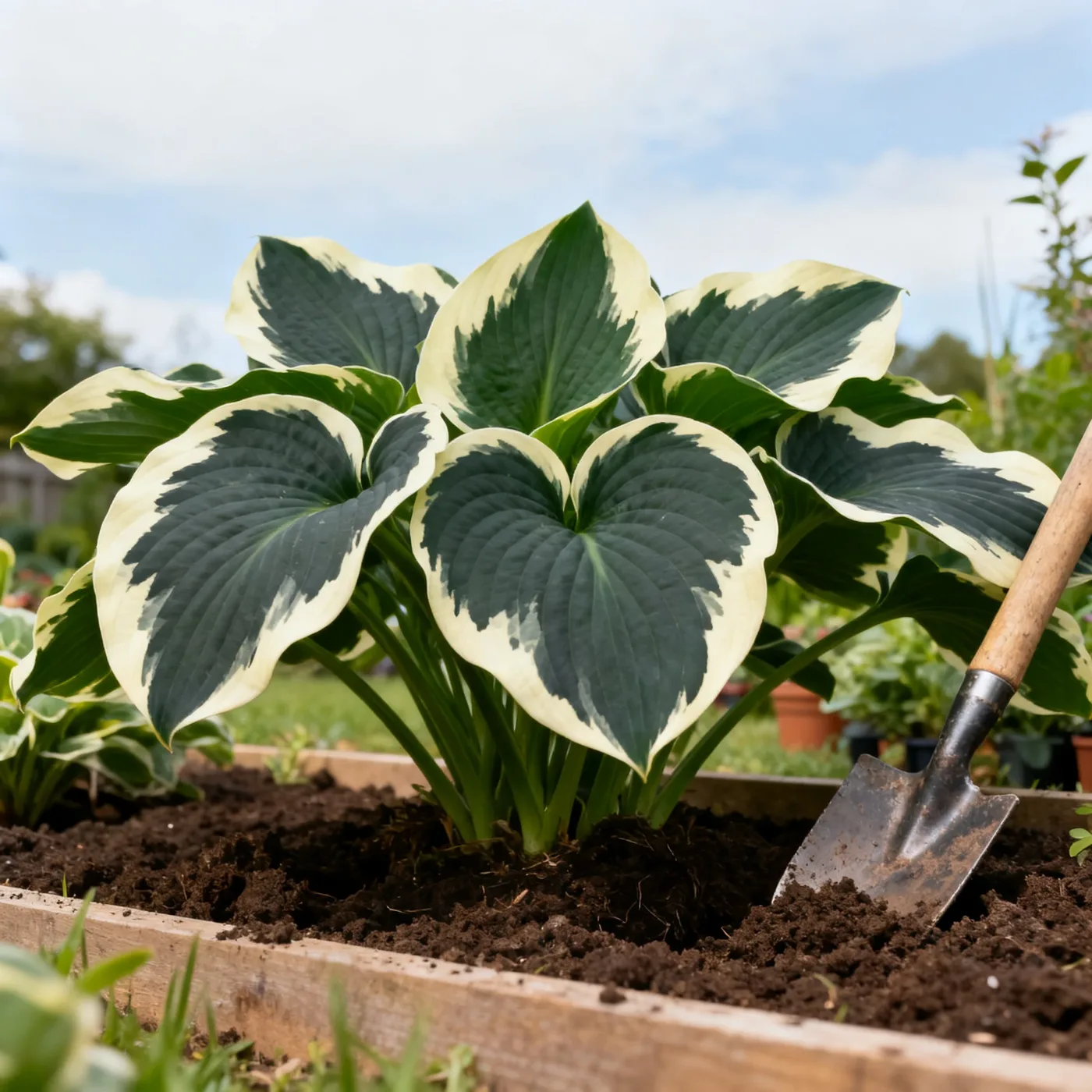
Pick one leaf from the middle of the clump and lay it flat. The blade is ovate, meaning egg-shaped: broadest near the base, tapering to a point at the tip. The center is a deep, dark green, and a band of ivory-white runs all the way around the outside.
The Margin
The margin is the signature. It measures about an inch wide and takes up roughly one-fifth of the leaf's width on each side, which is a lot of white on a leaf this size. It is also irregular. The line between white and green wanders and scallops, nibbling into the green in some spots and pulling back in others, so no two leaves match and no ruler could draw it.
That wandering edge is what separates Patriot from hostas with a tidy, narrow border. If you are stuck between look-alikes, our comparison with Hosta Francee walks through the differences.
Surface and Ribbing
Hosta leaf texture is often shiny and smooth, but can be puckered or powdery. Patriot is on the glossy side, with a sheen on top that catches low sun. Run a thumb along the blade and you feel the veins as parallel ribs curving from the midrib out toward the margin, and the green between them sits slightly sunk.
The white band has the same glossy surface but looks flatter, since it reflects more light. Here is a quick check you can run on your own plant:
- The center of each leaf is solid dark green, with the variegation confined to the outside band.
- The margin is white to ivory, about an inch wide, and wavy rather than straight.
- The leaf is egg-shaped, roughly 7 by 5 inches on a settled plant.
- The top surface is glossy, with ribs running in smooth curves from midrib to edge.
How Plantation Lily Changes From Emergence to Frost
The plant you see in April is not the plant you see in September, and a lot of the "that doesn't look right" questions we get come down to timing. The table below lays out what to expect at each stage, with the details after it.
| Stage | What you will see |
|---|---|
| Spring emergence | Furled green spears with a pale stripe on the edge, margins at their cleanest of the year |
| Early summer | Fully open, glossy leaves with the 1-inch white margin and a rounded mound |
| July to August | Lavender-blue flower stalks above the foliage, first scorch or slug damage on edges |
| Fall to frost | Fading, floppy leaves, then collapse after a hard freeze |
Spring and Early Summer
New shoots come up as tight, rolled spears, and the white edge is already visible as a pale line on the furl. As the leaves open, the margin is at its freshest, before sun, slugs and rain have had their say. Clemson Extension calls slugs the most common hosta problem, and a hole punched through a white margin shows from a long way off, so look closely at spring growth.
By early summer the mound is full and the leaves are glossy and flat. This is the look most photos capture, and it is what you should expect when light and water are right.
Bloom and the Hard Months
Hostas bloom in July and August, and on Patriot the flowers are lavender-blue, held on stalks above the leaves. They are pretty at close range and secondary to the foliage. Our guide on when Plantation Lily blooms covers timing and color in more detail.
Heat and dry sun are harder on the white. Hosta leaves in dry, sunny locations often burn or develop brown edges, and heavily variegated types belong in shade. The pale margin is where that browning shows up first. If yours is crisping, read our notes on sun requirements before you reach for the fertilizer.
In fall the whole plant relaxes. The leaves fade, flop outward and lose their gloss, with the margins usually going first. The first hard frost turns the foliage to a limp heap, and by then the show is over until the spears appear again.
What the Eye Settles on in the End
Strip away the photography and Plantation Lily is a mid-sized, rounded hosta with dark green, glossy, egg-shaped leaves about 7 inches long, each edged with a wandering white band around an inch wide. From across the yard it reads as green mounds outlined in white. Up close you get the ribbing, the sheen and the irregular margin that no other white-edged hostas imitate quite the same way.
The look changes through the year, strongest in late spring and early summer and tired by fall, and it stays crisp only where the leaves get shade from the hot sun. From the kitchen window, expect a neat dark mound with a white outline, a few lavender-blue flowers in midsummer, and a limp pile after frost.
Plantation Lily
Nursery-grown Plantation Lily in sizes from 1 Gallon, shipped to your door.
From $35.97
Shop Now →Our Plantation Lily beds get soil that holds moisture without ever turning soggy, plus enough tree cover to keep the afternoon sun off those white margins. Everything we sell comes from growers who do the planting, watering and watching ourselves, because we run a small business and not a resale operation. Once you have pictured that dark green mound outlined in white in your own yard, choose a Plantation Lily from our shop to begin with.