Plantation Lily vs Green Patriot and Reverse Patriot Hosta
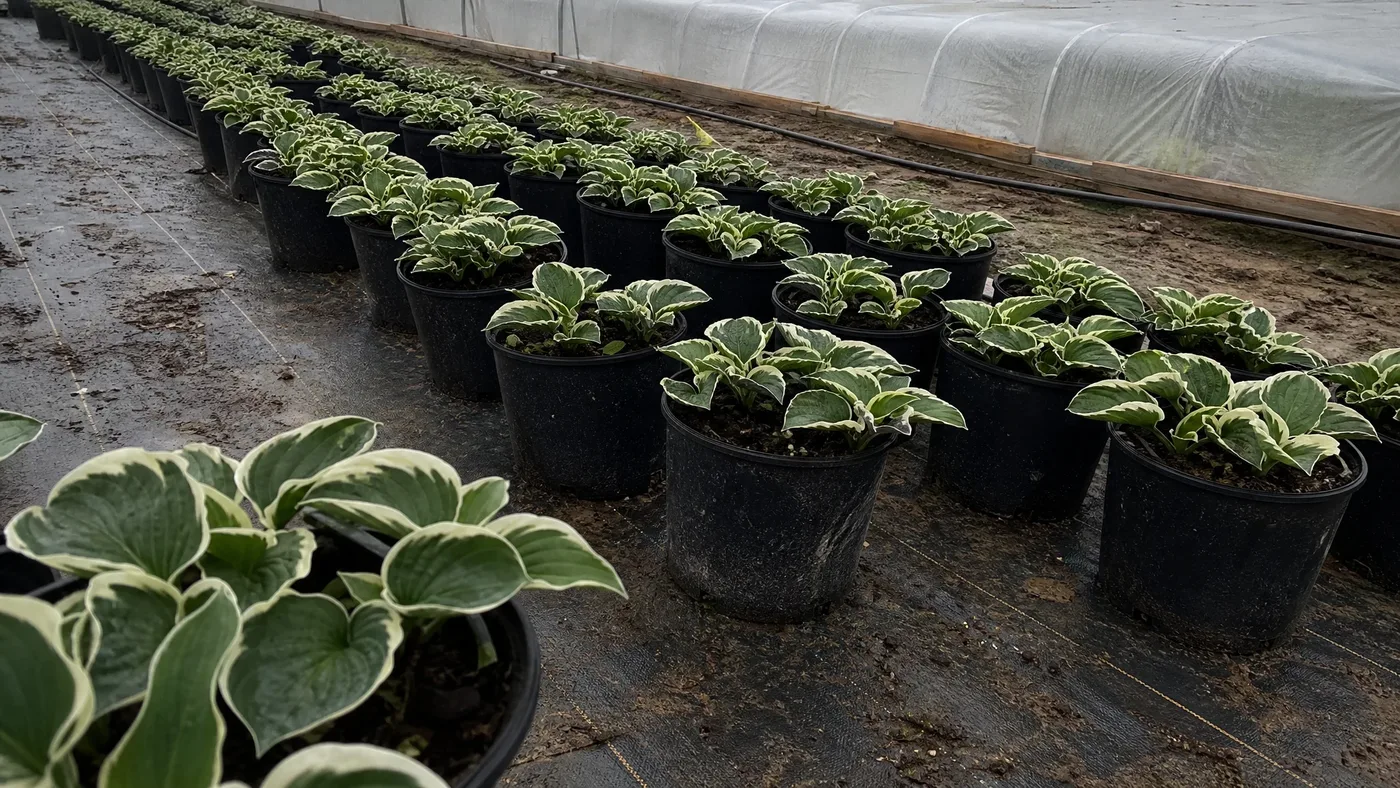
Three plants are sold under one name, and each has a different margin. True 'Patriot' has dark green leaves edged in white. 'Green Patriot' has no edge at all. 'Reverse Patriot' puts the white in the middle and the green on the outside. The question gets urgent in spring, when pots show up in stores with a tag that says only Patriot and the leaves are barely unfurled.
A seller can ship the wrong one without knowing it. You find out in June, when the clump fills in and the pattern is not what you paid for.
In this article, we'll go through what makes each sport a separate plant, how stable they are from division, why a clump can throw green shoots, and what to check when a plant arrives. Our position is simple: the margin pattern decides the plant, not the tag.
Is Green Patriot Just a Plain Plantation Lily?
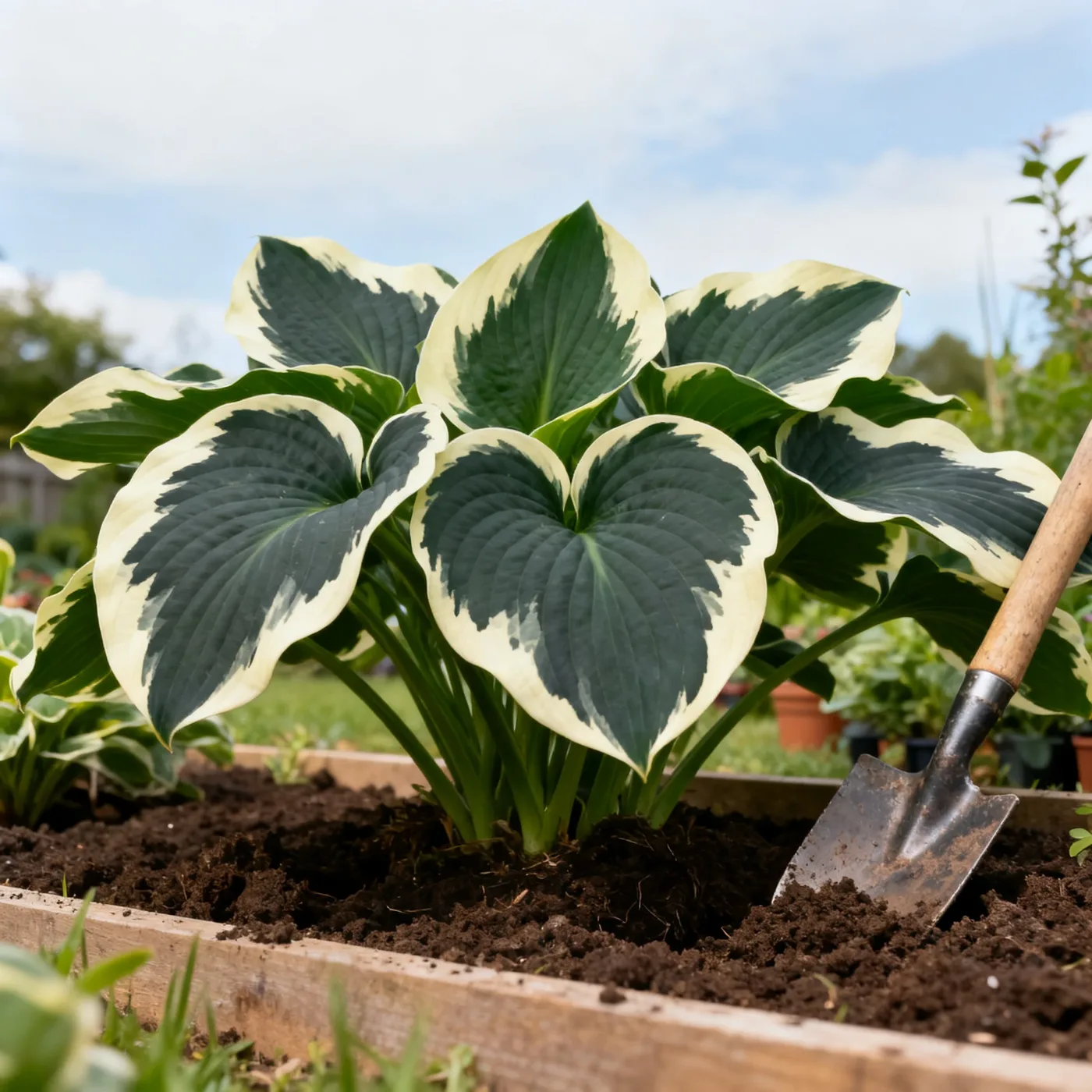
No. It is a separate plant, and the difference is the one feature that defines Plantation Lily. True 'Patriot' has dark green leaves with a wide white margin and grows 12 inches tall by 30 inches wide. 'Green Patriot' is an all-green sport of it. The leaf has no white edge, so there is nothing to brighten a shady corner.
People assume the two are interchangeable because the leaf shape and mound habit look the same. They are not interchangeable in the garden. A white margin is what makes Patriot read as a bright outline against dark mulch. Take it away and you have a plain green hosta, which is a fine plant but a different job.
Searches for Green Patriot size come up often, and we will be straight about it: we have no verified figure for it. Do not assume it matches the 12 by 30 inches of true Patriot. The genus runs from 4 inches to 2 feet 6 inches tall, so a guess is a poor basis for spacing. Ask the seller for the mature size, or check with your local extension service.
What we tell customers is this. Buy Plantation Lily itself if you want the white edge. Buy Green Patriot only when you want a quiet, even green mass and you are paying a price that reflects that. It should not cost the same as a white-margined plant, and it should never arrive in a pot labeled plain Patriot.
Reverse Patriot Is Not a Weak Plantation Lily
'Reverse Patriot' is the other sport, and it gets dismissed as an inferior copy. That is wrong. It is a distinct plant with the pattern flipped: a white center with a green edge. It is not a Patriot that failed to develop its margin. In the language of hosta judges, true Patriot is marginal variegated and a reverse-type sport is medio variegated, as Missouri's hosta guide sets out when it lists the leaf color categories.
The table lays the three side by side. Use it as a field key at the nursery bench.
| Plant | Center of leaf | Edge of leaf | Pattern type |
|---|---|---|---|
| Patriot | Dark green | Wide white margin | Marginal variegated |
| Green Patriot | Green | Green, no white | Solid green |
| Reverse Patriot | White | Green | Medio variegated |
The practical difference is where the pale tissue sits. Clemson's fact sheet notes that sunscald first shows on the white or lighter sections of variegated hosta leaves. On Patriot that means the edges brown first. On Reverse Patriot the pale part is the middle of the leaf, so we give it protection from hot afternoon sun. Our sun requirements guide covers the light range in detail.
Our candid pick: most customers should choose true Patriot, because the white frame is the look they came for. Choose Reverse Patriot if you want a lit-up center, and plant it where you look down on it, along a path or beside steps. It earns a place on its own merits.
Sports Stay True From Division, With Limits
A sport begins as a change in one shoot, and division is how it gets multiplied. When you split a crown, each piece is a section of the same plant. It carries the pattern of the eyes it contains. A division cut from a white-margined eye grows white-margined leaves. A division cut from a green eye grows green ones.
That is why the belief that sports never change is half right. The pattern is stable in the sense that a divided eye does not wander from one look to another. But the clump itself can hold more than one pattern at once, so the pattern of each division depends on which eyes you cut. The dividing knife decides, not the label on the original pot.
Seed is a different story. Do not sow seed from a Patriot-type plant and expect a copy. Flowers are produced from early summer to fall, depending on the cultivar, and Plantation Lily carries lavender-blue blooms in summer, but those flowers are for looks and bees, not for reproducing the plant. Division is the method that keeps the margin.
When you divide, work eye by eye. Keep divisions whose leaves show the margin you want. Plant any all-green or mismatched piece in a separate spot, or discard it. Our guide on dividing Plantation Lily in spring walks through the cuts and the timing.
Can a Plantation Lily Revert to All Green?
Yes, and it happens more often than sellers admit. Green Patriot itself shows how: it arose as a green shoot from a white-margined plant. The same thing can occur in a clump you already own. A single green crown appears at the edge, and it does not stay polite. Green tissue usually grows faster than white-margined tissue, so left alone the green section tends to crowd the pattern out.
We often see this in older clumps, where one fan of leaves has lost its white edge while the rest of the plant looks right. Customers usually notice it in early summer when the leaves are fully open. The better time to catch it is spring, when the new shoots are still tight and you can compare their color from the base.
Here is what we do about it:
- Check the clump every spring as the shoots emerge, and again in early summer when the leaves open.
- Cut out any all-green crown with a sharp spade, taking it down to the base with its roots so it cannot resprout.
- Replant the removed piece elsewhere if you want a Green Patriot-style plant, or discard it.
- Do not wait a year to see whether the shoot corrects itself. It will not.
Prompt removal keeps the white-margined part of the clump dominant. It takes ten minutes, and it is far easier than lifting and rebuilding a clump that has gone mostly green.
The Patriot Name Does Not Guarantee a White Margin
Any plant sold as Patriot is not necessarily Patriot. Tags are printed upstream, pots are filled by the hundreds, and a green or reversed shoot in a flat of white-margined divisions ends up under the same label. Another source of mix-ups is look-alikes. 'Francee' is the white-margined hosta most often confused with Patriot.
The leaf gives you numbers to work with. Iowa State lists Patriot as 7 inches long and 5 inches wide, dark green with 1 inch wide white margins and glossy on top. It was introduced in 1991. Francee has a larger 9 by 6 inch dark green leaf with white margins and was introduced in 1986. So a leaf that is clearly bigger than Patriot's may not be Patriot at all.
Check three things on any pot labeled Patriot:
- Every leaf has a white edge, not just most of them.
- The margin is wide, about an inch on a mature leaf, and the center is dark green.
- The leaf size and gloss match the figures above.
If you want the details of how the look-alike differs, read our comparison of Plantation Lily and Hosta Francee. For the wider family, see Plantation Lily varieties and cultivars compared. A name is a claim. The leaf is the evidence.
Tissue-Culture Plants Are Not Always Correct
Lab-grown stock is often sold as guaranteed true to type. We would not rely on that. Tissue culture multiplies tiny pieces of a plant at scale, and variegated plants are the hardest to keep consistent because the pattern depends on which cells are in which layer. Some tissue-cultured plants come out of the flask with a weaker margin, a different pattern, or none.
The trouble is that a small plant tells you little. Young leaves on a plug or a one-gallon pot may not show the margin clearly yet. One of the most common questions we get is whether a thin-edged young plant will fill in. Our answer is to judge it on its most mature leaves, not on the newest ones, and to buy a size that shows a few full leaves. Our buying guide on container sizes explains what each size lets you see.
What to Verify on Arrival
Do the check the day the plant arrives, while you can still go back to the seller. Look at these points:
- Open the pot and count the shoots. Every shoot should show the same margin pattern as the others.
- Compare the largest leaf to the 7 by 5 inch size for Patriot. A much larger leaf points to a look-alike.
- Photograph the plant and the tag together, with date, and keep both until the first summer has passed.
- Ask the seller in writing what the plant is propagated from and what their replacement policy covers.
If a seller cannot answer, that tells you what you need to know.
Settling the Plantation Lily Naming Muddle
Here are the verdicts in order. Each is based on the margin, because it is the one feature a tag cannot fake.
- Green Patriot is its own plant. It is an all-green sport with no white margin, and it should be sold and priced as such.
- Reverse Patriot is its own plant. It has a white center and a green edge, and it is neither a weak Patriot nor a mislabeled one.
- Sports hold their pattern through division. Each piece keeps the look of the eyes you cut, so choose eyes with care.
- Reversion is common enough to plan for. Cut out green crowns early at the base.
- A Patriot tag proves nothing. The same goes for a lab-grown label. Trust the leaf.
None of these verdicts depends on a rare trick of identification. They depend on looking at the plant before you plant it.
Buying the Right Plantation Lily
True Patriot is the plant with a wide white edge on a dark green leaf, about 12 inches tall by 30 inches wide. Green Patriot loses the edge and Reverse Patriot swaps it into the center. All three are good plants. The problem is only ever the wrong one in the right pot, so look at the margin before you pay.
Before you pay, confirm these four things:
- The pattern on every leaf matches the name: green center, white edge.
- No shoot in the pot is solid green or reversed.
- The leaf size is near 7 by 5 inches, not the larger Francee leaf.
- The seller will replace the plant if it turns out to be the wrong sport.
Plantation Lily
Nursery-grown Plantation Lily in sizes from 1 Gallon, shipped to your door.
From $35.97
Shop Now →Plantation Lily sits in filtered shade on our farms, in soil that stays moist, drains well and is rich with organic matter, and it gets about an inch of water each week. We are a small business of growers, and every plant we sell was raised by us, so we look over each clump's margin ourselves. If you would like a Patriot you can trust to match its name, begin with one of ours.