Plantation Lily vs Fire and Ice Hosta: Size and Variegation
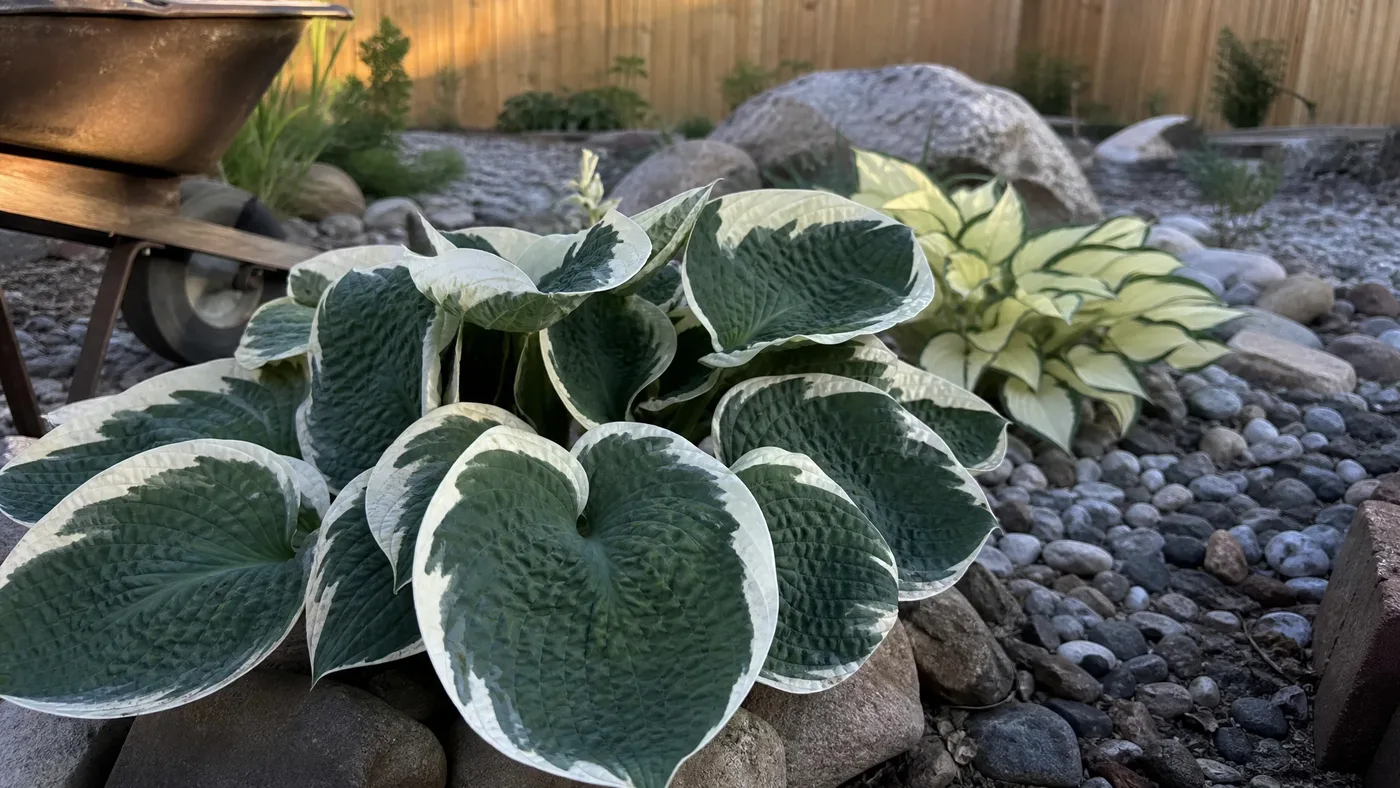
Which pattern is on this tag: is the white in the middle of the leaf, or along its edge? That one question settles most mix-ups between Plantation Lily and Fire and Ice. Plantation Lily has a green center and a wide white margin. Fire and Ice reverses it, with a creamy-white center and a dark green border. Size separates them too, and Plantation Lily is the one that takes up real room, at about 30 inches wide.
Below, you'll find out all about how these two hostas differ, including how to tell them apart by leaf, how each pattern reads from across the yard, what size means for a small bed, how each handles bright light, and which neighbors suit which leaf. Choose wrong and you get a clump that crowds its bed, or a pale-centered leaf that browns in summer sun. Choose right and the leaf does the work for years.
Green Center or White Center on Plantation Lily?
Ignore the name on the pot and read the leaf. The American Hosta Society sorts hostas into five leaf color categories, and two of them matter here. Marginal variegated means light margins with a dark center, which is Plantation Lily. Medio-variegated means dark margins with a light center, which is Fire and Ice.
Use this check on any tag or unlabeled pot:
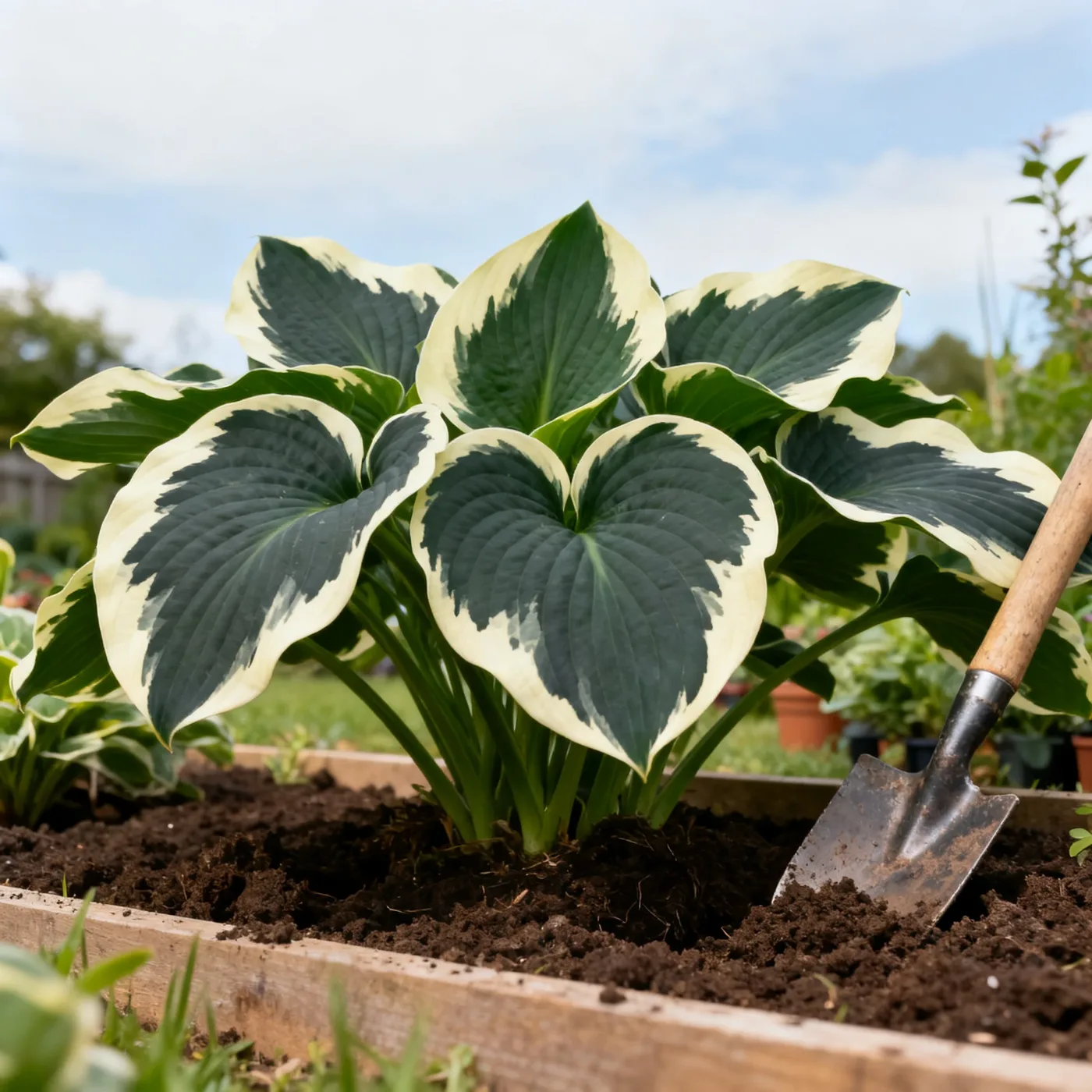
- If the middle of the leaf is green and a wide white band runs around the edge, you have Plantation Lily. The band can read as white or slightly yellow, and both are normal for this cultivar.
- If the middle of the leaf is creamy white and a dark green border frames it, you have Fire and Ice.
- If one pot shows both looks, judge by most of the leaves. A single odd leaf is a sport, but two patterns side by side usually mean two plants sharing a pot.
Flowers will not settle it. NC State lists lavender blooms for both, so the summer scapes look alike. One of the most common questions we get is whether a tag was swapped, and the leaf pattern almost always answers it. Size is the second clue, and we get to it below.
Why Reverse Patterns Fool the Eye From a Distance
The two patterns are mirror images, so you might expect them to read as mirror images from the sidewalk. They do not. Where the white sits decides what your eye grabs first, and that changes with distance.
Up Close
Within a few feet, Plantation Lily reads as an outline. The white margin traces every leaf, so you see the shape of each blade and the ripple of its edge, with the green middle as a calm field. Fire and Ice works the other way. The bright center pulls you in, the dark margin acts like a picture frame, and you notice the variegation inside the leaf rather than its edge.
From Across the Yard
Distance blurs detail, and the two patterns blur differently. On Plantation Lily, the white edges merge into a lacy bright trim around a dark green mass, so the clump looks deep and sharply defined. On Fire and Ice, the pale centers merge into a glowing mound while the dark margins nearly vanish, so the clump looks lighter and softer.
At dusk, whatever is lightest shows first: the edge on one plant, the whole center on the other. Our read is that Plantation Lily is the more graphic plant and Fire and Ice the brighter, softer one. Pick by where you will be standing when you look at it. A plant meant for a window view or a front walk is judged up close, and one at the back of a lot is judged from far off.
Plantation Lily Spreads Wide While Fire and Ice Stays Compact
Plantation Lily is the bigger clump. Clemson's extension lists it at 12 inches tall by 30 inches wide, so the mound spreads more than twice as wide as it is tall. That low, wide shape is why the white margins layer into a skirt around the plant.
Fire and Ice is the tidier of the two. NC State puts both in the medium-size group, but Fire and Ice holds a smaller, tighter clump. We will not quote a number for it here, so check the size on your grower's tag or with your local extension service. Our guide to Plantation Lily size and growth rate covers how quickly it fills out. Hostas grow at a medium pace, so expect a few seasons.
This table sets the two side by side.
| Trait | Plantation Lily | Fire and Ice |
|---|---|---|
| Leaf pattern | Green center, wide white margin | Creamy-white center, dark green margin |
| Size group | Medium | Medium |
| Mature clump | About 12 inches tall, 30 inches wide | Smaller, tighter clump (check the tag) |
| Flowers | Lavender | Lavender |
For spacing, hostas generally go 1 to 3 feet apart. With Plantation Lily, plan for the wide end of that range, even if the plant in your hand looks small.
A young Plantation Lily looks modest for its first season or two, then fills its full width. Plant it where you will not need to move it, because the gap you leave now is the space it will want later. Fire and Ice fills its smaller footprint sooner, which makes it the easier choice if you want a finished look quickly.
When a Small Bed Rules Out Plantation Lily
A 30-inch spread is fine in an open bed and a problem almost everywhere else. What we tell customers is simple: if the bed is narrower than the clump will be, choose Fire and Ice. You cannot trim Plantation Lily to fit, because cutting leaves back leaves ragged edges right where the white margin shows.
These are the spots where size becomes the problem:
- Narrow borders. If the strip is shallower than the clump is wide, the outer leaves will flop onto the lawn or the path.
- Path and walkway edges. The skirt of leaves leans outward and hides the line you wanted the plant to mark.
- Tight mixed plantings. Every neighbor inside that 30-inch circle ends up under Plantation Lily's leaves.
- Containers. Plantation Lily can live in a pot, and our guide to growing it in containers shows how, but it needs a wide pot. Fire and Ice stays in proportion to a smaller one.
Here is a quick test. Lay a garden hose in a 30-inch circle where you want the plant. If the circle spills onto a walk, runs into a wall, or lands on other plants, Plantation Lily is the wrong choice for that spot. One plant given its full circle beats three squeezed into the same space.
Sun That Bleaches One Hosta and Scorches the Other
No hosta likes all-day sun. South Dakota State's extension says very few, if any, will do well in strong, direct light all day. Plantation Lily is a little more forgiving than most, since the cultivar is listed for full sun to partial shade, but the white in the leaf decides where each plant fails.
White tissue has little green to protect it. On Plantation Lily, damage starts at the margin. On Fire and Ice, it starts in the pale center, while the dark green frame stays fine.
| Light problem | Plantation Lily | Fire and Ice |
|---|---|---|
| Too much sun | White margin turns brown and papery | Pale center bleaches or burns in patches |
| What holds up | Green center | Dark green margin |
| Our fix | Morning sun, afternoon shade | Shade through midday and afternoon |
| Too little sun | Slower growth | Slower growth |
In our rows, the first crisped leaf on a white-margined plant is almost always on the side facing afternoon sun. Dry soil speeds up the burn on either plant, and hostas want about an inch of water a week.
Pots make this worse. A container heats and dries faster than the ground, so either hosta in a pot on a sunny patio browns sooner than the same plant in a bed.
Common advice says to give white-patterned hostas the deepest shade you have. We would not go that far. Minnesota's extension notes that too dark a location leads to slower growth. Dappled shade or a few hours of gentle morning light holds the pattern and the pace. Our shade tolerance guide goes further.
Wrong Neighbors and Right Neighbors for Each Leaf Pattern
With both of these, the leaf is the show, so a bad neighbor costs you the pattern. Plan around where the white sits.
Companions for Plantation Lily
The white margin needs something dark behind it to stand out. Dark green ferns, evergreen shrubs and deep-colored foliage make the edge look sharp. Wrong neighbors are other white-edged hostas and pale variegated plants growing right behind it. Their light edges compete with Plantation Lily's, and the outline you paid for gets lost.
Companions for Fire and Ice
The pale center is the feature, so keep dark foliage at its base and sides. Burgundy or deep green leaves frame it well. Avoid other bright-centered hostas and gold foliage nearby, which turns the planting into one pale wash.
Watch the background too. A white fence, pale wall or light paving swallows Plantation Lily's margin, while Fire and Ice keeps its dark border against the same backdrop and stays legible. Our landscape ideas and companion plants guide has more pairings for Plantation Lily.
If you want both in one garden, keep them apart. Put one pattern in a group and let the other stand as a single accent in a different bed, so the eye reads each leaf on its own terms.
Picking Plantation Lily or Fire and Ice by Site
We would choose Plantation Lily for most open beds, because it fills space and holds a clear outline. We would choose Fire and Ice when space, not taste, is the limit. Use these rules in order:
- A roomy bed with a dark backdrop of conifers, ferns or a shaded fence: Plantation Lily.
- A narrow border, a path edge or a pot: Fire and Ice.
- A spot backed by a white fence, pale wall or light paving: Fire and Ice, because the dark margin keeps each leaf distinct.
- A site with some morning sun and afternoon shade: Plantation Lily, since its green center copes better with light than a white one.
Soil does not separate them. Both want moist, well-drained, organic-rich soil, so the choice comes down to leaf and space.
Matching the Leaf to the Spot
Read the leaf first. A green center with a white band is Plantation Lily, and a creamy center with a dark border is Fire and Ice. Plantation Lily is the larger plant at about 12 inches tall and 30 inches wide. Its white edge burns first, while Fire and Ice burns in the middle.
Our rule of thumb is two branches. A roomy bed with a dark backdrop means Plantation Lily. A small or bright-edged spot means Fire and Ice.
Plantation Lily
Nursery-grown Plantation Lily in sizes from 1 Gallon, shipped to your door.
From $35.97
Shop Now →Partial shade and soil that holds moisture yet drains freely are what we give Plantation Lily on our farms, and they keep the white margin clean as the clump widens. We are a small team of growers tending top-quality plants on our own farms. Once you know whether your garden has room for the bigger hosta, come pick out a Plantation Lily of your own.